Telluride Science · 2025
Alternative Chemistries Beyond Earth
Venusian heteropolymers and Titan’s amino acids.
Venus / Project overview
Life on Earth gives us one chemical example. This study asks whether carbon-free polymer structures could be plausible in a very different planetary setting.
In brief
Some modeled routes to these carbon-free structures are chemically plausible under the chosen Venus-like conditions. That makes this family of molecules worth further investigation.
The study does not establish that these molecules exist in Venus’s clouds, how abundant they would be, or whether they could have a biological role. Real cloud chemistry involves processes the model does not capture.
The people behind the work
I joined Martin Rahm’s group at Chalmers through the CASSUM fellowship. The project began in the group before I arrived; I later led the final calculations and manuscript writing, working with the collaborators credited in the paper.
The approach
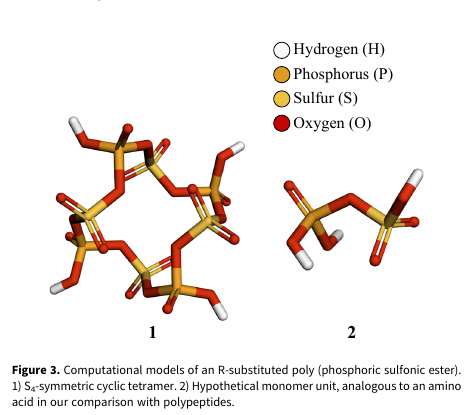
We use computational chemistry to examine model structures built from phosphorus, sulfur, and oxygen. Calculations test selected formation routes, bond-cleavage properties, and potential spectroscopic fingerprints under the study’s assumptions.
A finite chain has end groups that complicate comparisons. A small cyclic structure provides a manageable stand-in for a longer polymer, with limitations that matter when interpreting the results.
See the ideas take shape
Follow the setting, explore the model, and take a closer look at the evidence. Technical explanations are there when you want them.
Explore VenusAn open question
Go to the source
Ishaan Madan, Shekoufeh Arabi Aliabadi, et al. · QRB Discovery 6, e23
Telluride Science · 2025
Venusian heteropolymers and Titan’s amino acids.
A personal connection
This project grew out of my summer in Sweden before starting at Purdue: a chance to follow an unconventional question while learning what kind of scientific work felt meaningful to me.
Read that part of my story