AbSciCon · 2026
Prebiotic Chemistry Insights for Dragonfly
Thermodynamics of amino acid, nucleobase, ribose, and fatty acid synthesis in Selk crater on Titan.
Titan / Project overview
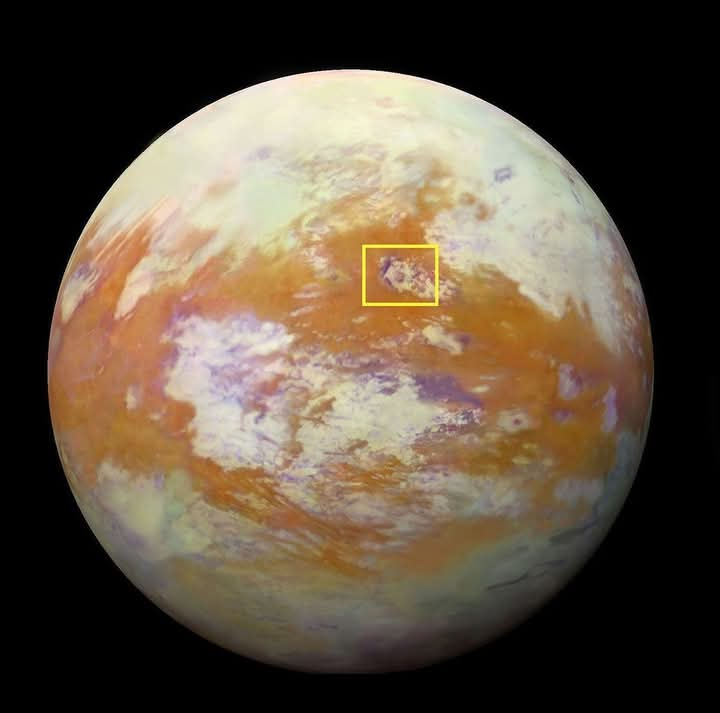
An impact can briefly turn Titan’s icy surface into liquid water. I study what chemistry might become possible in that temporary window.
In brief
In the reported models, adding a small amount of ammonia opens access to many more of the molecules studied. At 1% ammonia, 38 of the 40 investigated molecules are thermodynamically accessible, compared with five without added ammonia.
Energetic favorability does not establish how quickly reactions happen, how much material survives, or what a spacecraft will find. These calculations offer a chemical baseline to investigate, rather than evidence that life exists on Titan.
The people behind the work
I led these two complementary studies with Ben K. D. Pearce at Purdue. Together, they form the first chapter of my PhD: a shared thermodynamic view of amino acids, nucleobases, ribose, and fatty acids in a Titan-like melt pool.
The approach
We start with water and simple organic ingredients, then calculate which molecular arrangements are energetically favored. By varying the starting amount of ammonia, we ask how the accessible chemical inventory changes.
Ammonia changes the supply of hydrogen available to build molecules. The interactive lets you step through the reported starting concentrations and see how the modeled molecular inventory changes.
See the ideas take shape
Follow the setting, explore the model, and take a closer look at the evidence. Technical explanations are there when you want them.
Explore TitanAn open question
Go to the source
Ishaan Madan & Ben K. D. Pearce · The Planetary Science Journal 7, 107
Ishaan Madan & Ben K. D. Pearce · The Planetary Science Journal 6, 284
Open code & computational outputs on Zenodo (opens in a new tab)
AbSciCon · 2026
Thermodynamics of amino acid, nucleobase, ribose, and fatty acid synthesis in Selk crater on Titan.
Telluride Science · 2025
Venusian heteropolymers and Titan’s amino acids.
A personal connection
This work brought together the chemistry, computation, and planetary questions that drew me back to research after working in healthcare software.
Read that part of my story