Ishaan Madan / Scientist & curious human
Exploring other worlds.Discovering myself. I’m Ishaan, a PhD student in Planetary Science and Astrobiology at Purdue. I explore life’s beginnings through research, share science through teaching, and practice meditation as a way to understand myself.
Read my story Purdue University · NSF Graduate Research Fellow
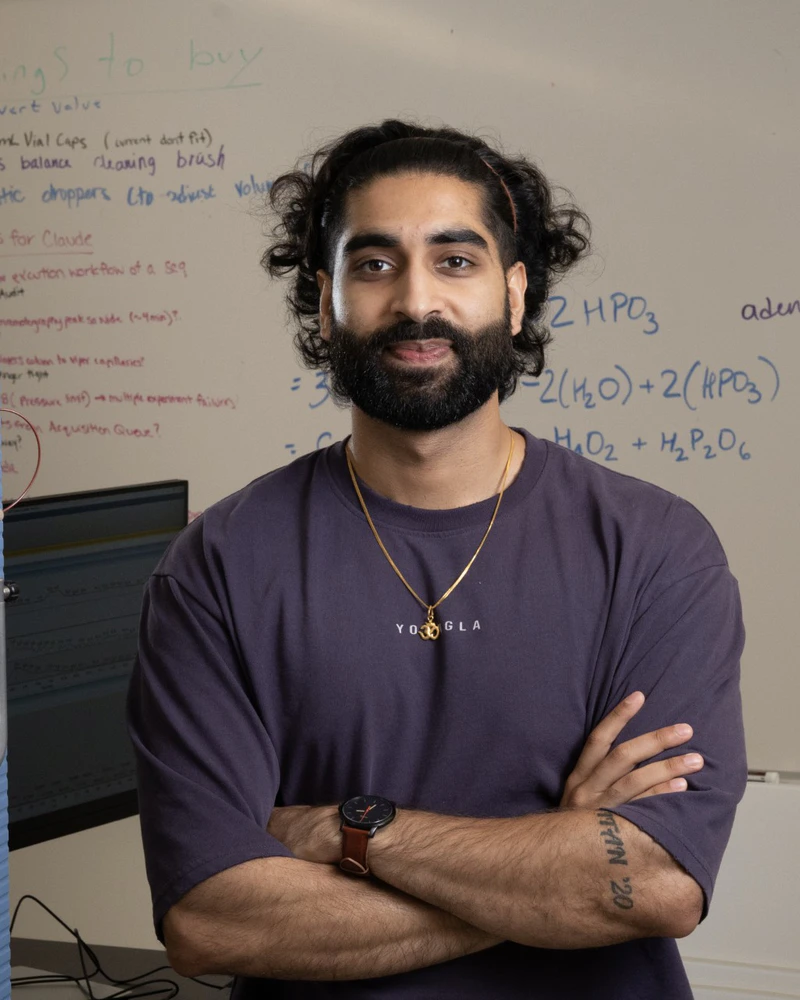
At Purdue, August 2025John Underwood / Purdue University (opens in a new tab)
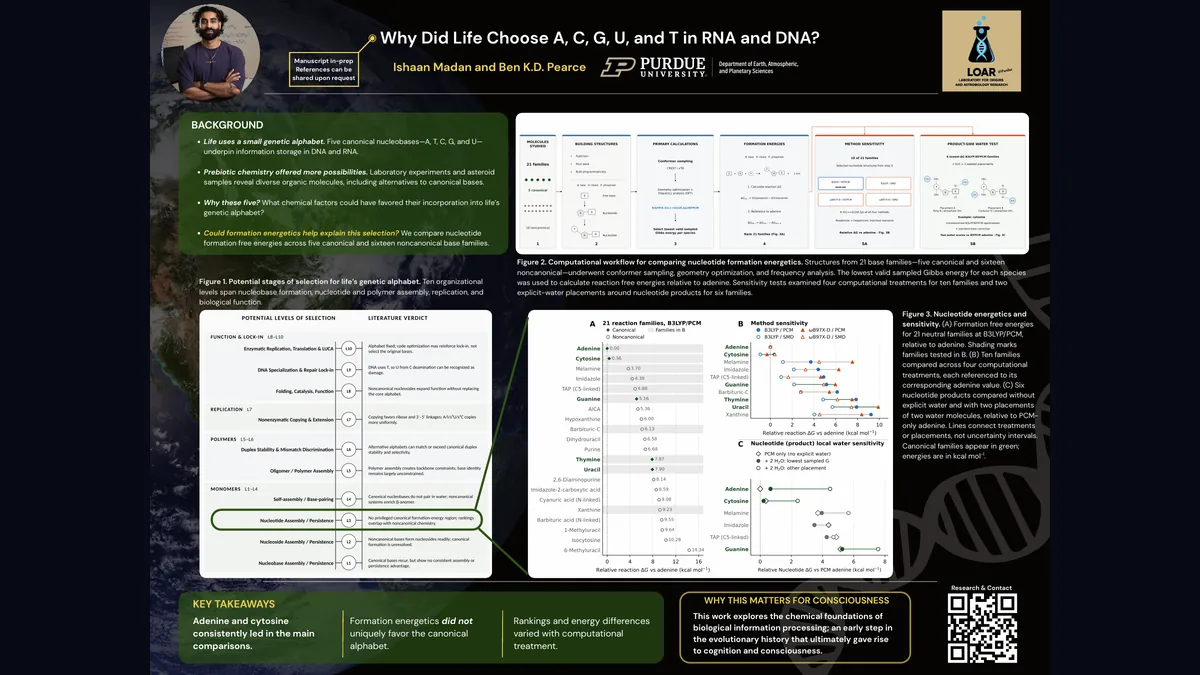
Latest from Ish TSC 2026 · October 2026 · Research poster
Why Did Life Choose A, C, G, U, and T in RNA and DNA? A poster comparing the formation energetics of 21 nucleobase families to ask why life uses its familiar genetic alphabet.
With Ben K. D. Pearce · Manuscript in preparation
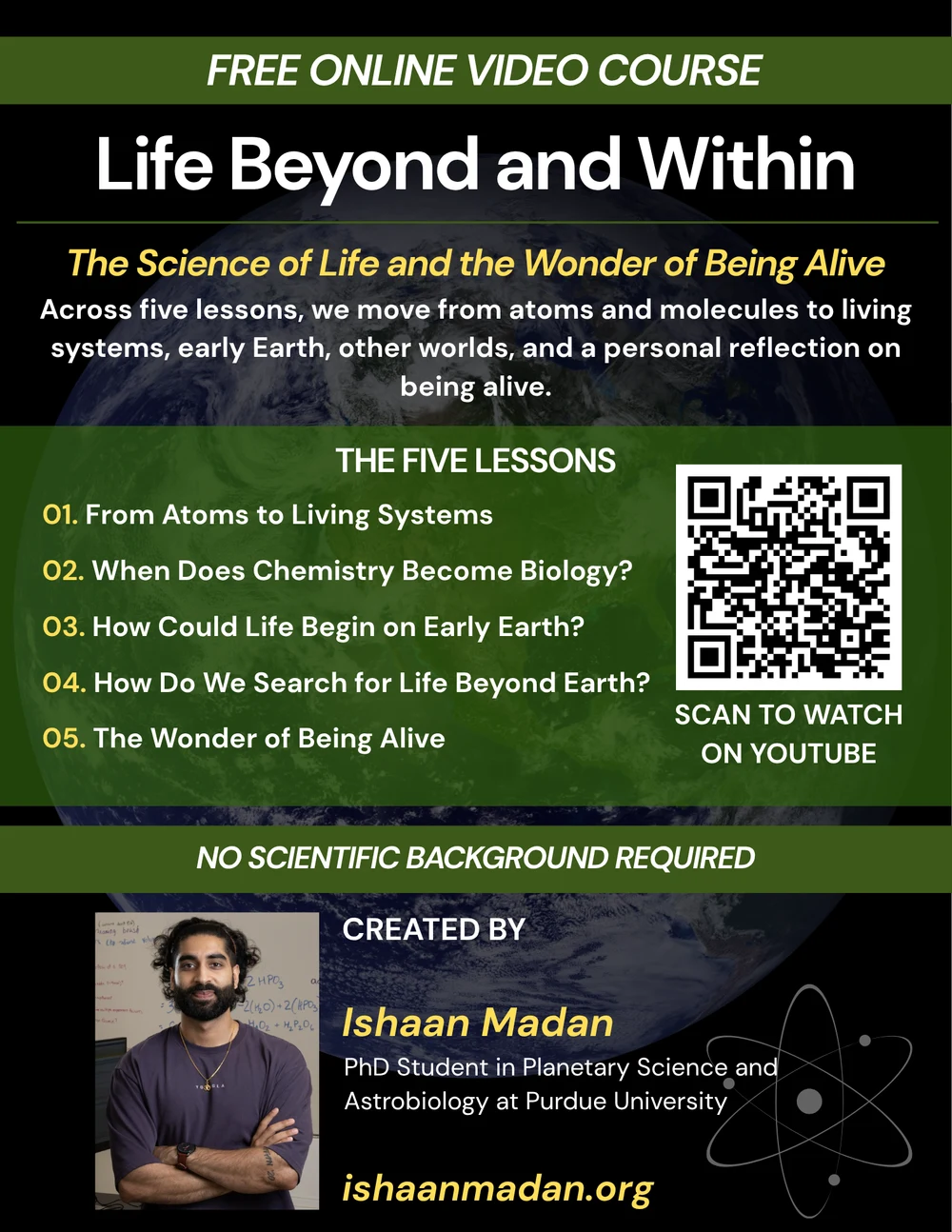
Download poster (PDF, 16 MB) September 2026 · Free video course · 5 lessons
Life Beyond and Within Explore the science of life, from atoms and early Earth to other worlds and the wonder of being alive.
No scientific background required.
Watch the course (opens in a new tab) Let’s have a conversation. A question, a shared curiosity, or something you’re working through.
Book a conversation